


When a 9 Becomes a 3: The Quiet Problem of Character Confusion in Handwriting AI
A surprising amount of the world still runs on handwriting. Insurance claim forms, delivery notes, bank and loan applications, invoices with handwritten amendments, meter readings, patient intake sheets, land and property registers, exam answer scripts, field inspection logs. Every one of them is full of numbers and short codes that someone eventually has to turn into data.

AI has become genuinely good at this. Modern vision-language models read messy handwriting far better than the OCR engines of a few years ago. But as part of ongoing work on extracting data from handwritten documents, I kept running into the same quiet failure — and it is worth talking about precisely because it is so easy to miss.
The model doesn't refuse to read a character. It reads it confidently, and it reads it wrong.
The usual suspect is not alone
Everyone knows the classic example: a handwritten 7 mistaken for a 1. Many writers cross their sevens specifically to prevent it. What I didn't expect was how far beyond that one pair the problem spreads.
Across the documents I reviewed, I confirmed nine distinct confusions:
Digits: 9↔3, 8↔9, 1↔7, 1↔2, 0↔2, 0↔6, 6↔8, 4↔9
Letters: E↔F, inside an alphanumeric code

Several of these make intuitive sense once you see them written quickly: an open-topped 9 drifts toward a 3, an 8 written without a clean pinch in the middle looks like a 9, a 0 with a small tail becomes a 6. Others only appear with particular writers or pens. Either way, the result reads as perfectly plausible data.
When the number of digits changes
Two further errors were more unsettling, because they changed a value's length rather than a single character:
A dropped digit. A six-digit reference like 418230 came back as the five-digit 41830 — and did so three separate times within the same document.
An inserted digit. A code like K310Q4 came back as K3108Q4, with a digit that nobody ever wrote.
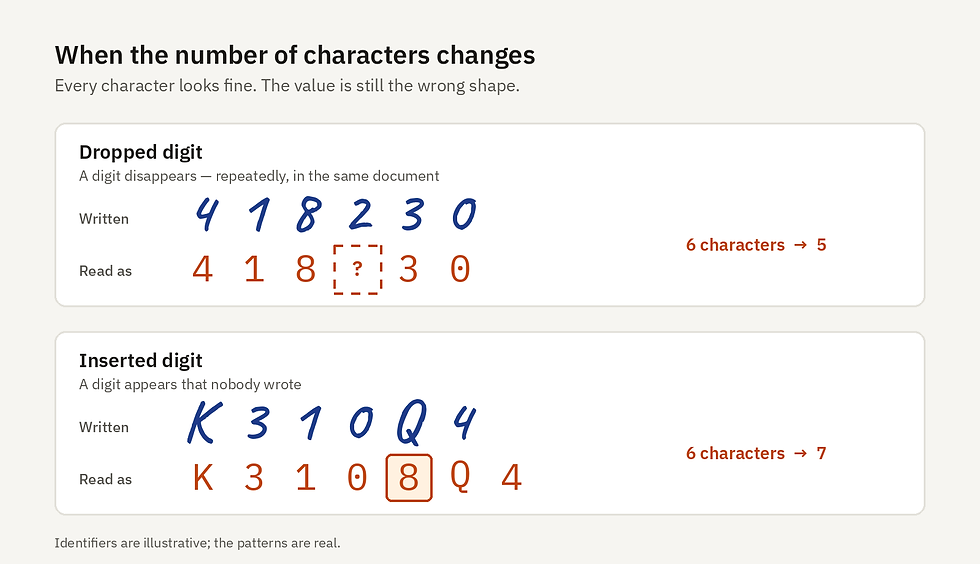
Character-level spot checks don't catch errors like these, because every individual character in the output may look fine. The value is simply the wrong shape.
Why it happens
This is not really a question of models being "not smart enough". It is a mismatch between the handwriting a model learned from and the handwriting in front of it. Handwriting habits vary by country, by generation, by profession, and by the speed at which a form is filled in. A crossed seven is standard in much of Europe and rare elsewhere. A clerk completing the fortieth form of a shift writes differently from the same clerk at the start of the day. Faint pens, carbon copies, low-resolution scans and boxes too small for the digits all make it worse.
The model does what it is designed to do: pick the most likely reading. On ambiguous strokes, the most likely reading is sometimes simply wrong — and nothing in the output signals the difference.
Why it matters everywhere paper does
A wrong character rarely looks wrong. A total of 1,850 read as 1,350 is still a sensible-looking total. A policy number missing one digit is still a number. A date of the 19th read as the 13th is still a valid date. Because the error is plausible, it slips through.
The consequences depend on the industry, but the shape is the same:
Finance and insurance: an amount, an account number, or a claim reference that is off by one character leads to a mismatched payment, a failed reconciliation, or a claim attached to the wrong record.
Logistics and retail: a quantity or SKU misread on a delivery note becomes a stock discrepancy that someone spends hours tracing.
Utilities and field services: a misread meter reading turns into a disputed bill.
Healthcare: a dose, a weight, or a patient identifier read incorrectly is a safety issue, not a data-quality one.
Education and government: a single marks total, roll number, or survey number read wrong can change an outcome for a real person.
In every case, the cost of the error is far greater than the cost of catching it — provided you know where to look.
Why a "watch list" of confusing pairs stops working
The natural first reaction is to keep a list of known risky pairs and double-check those. I tried thinking that way too. It works while the list is short. But once the confirmed pairs cover most of the digits from 0 to 9 — plus letters, plus digits that vanish or appear — the list is no longer telling you anything. It is just describing handwriting.
The more useful shift is in posture: treat every handwritten character in a critical field as unverified until something corroborates it.
The document usually already knows the answer
Here is the encouraging part. Most business documents carry their own internal logic, and that logic exposes misreads without anyone needing to be a handwriting expert:
Arithmetic. Line items should add up to the total. Gross minus tare should equal net. Opening balance plus movements should equal closing balance. If the sum doesn't reconcile, a digit is wrong somewhere.
Impossible values. A time of 04:99, a date of 31 February, a percentage of 140% where 100% is the maximum — none of these can exist, so none of them should pass.
Expected ranges. Forms often print the acceptable range right next to the box: a weight between 10 and 12 kg, a reading below a set limit. A value outside it deserves a second look before anyone assumes the process went wrong.
Check digits. Many identifiers carry built-in checksums — bank card numbers, IBANs, many national ID formats — so a single wrong digit often makes the number provably invalid.
Expected shape. If a reference number is always six digits, a five-digit or seven-digit result is wrong even when every individual character looks right. This is exactly what catches dropped and inserted digits.
Consistency. The same customer number, order number, or batch number often appears several times across a document. If one occurrence disagrees with the others,
at least one of them has been misread.

None of these checks requires reading handwriting better. They require reading the document as a whole rather than character by character, and treating disagreement as a signal worth surfacing to a person instead of something to quietly smooth over.
Takeaways
Character confusion is broad, not a single famous pair. Expect it across most digits and some letters, and expect values to gain or lose characters entirely.
Plausible is not the same as correct. The most dangerous misreads are the ones that look like perfectly reasonable data.
Don't rely on watch lists. Treat critical handwritten fields as unverified by default.
Let the document check itself. Sums, ranges, impossible values, check digits, expected lengths, and cross-references catch a large share of errors at almost no cost.
Route disagreements to a person. The goal isn't a system that never doubts itself; it knows when it should.
Handwriting AI will keep getting better at reading individual characters. But for anyone turning paper into data — in any industry — the more reliable gains are likely to come from systems that check what they read against what the document itself says is possible.
The End.



Comments